
Inquiries-Week 7: EOOEOEEO


Introduction
Let's start with E. Its opposite is O. So if we flip E, we get O. Let's make a pattern.
E
E O
E O O E
E O O E O E E O
How is this pattern constructed? What comes next? Write it down before you scroll.
Ready
for
the
next
in
the
sequence?
E O O E O E E O O E E O E O O E
- What do you notice about the pattern?
- Do you have any conjectures about it?
- Is there a way to predict if an individual letter will be an E or an O in the pattern? For example, for the next one, what will the 20th letter be?
E
E O
E O O E
E O O E O E E O
E O O E O E E O O E E O E O O E
Ok, now stash this for a moment while we head over to zeros and ones.
And now binary
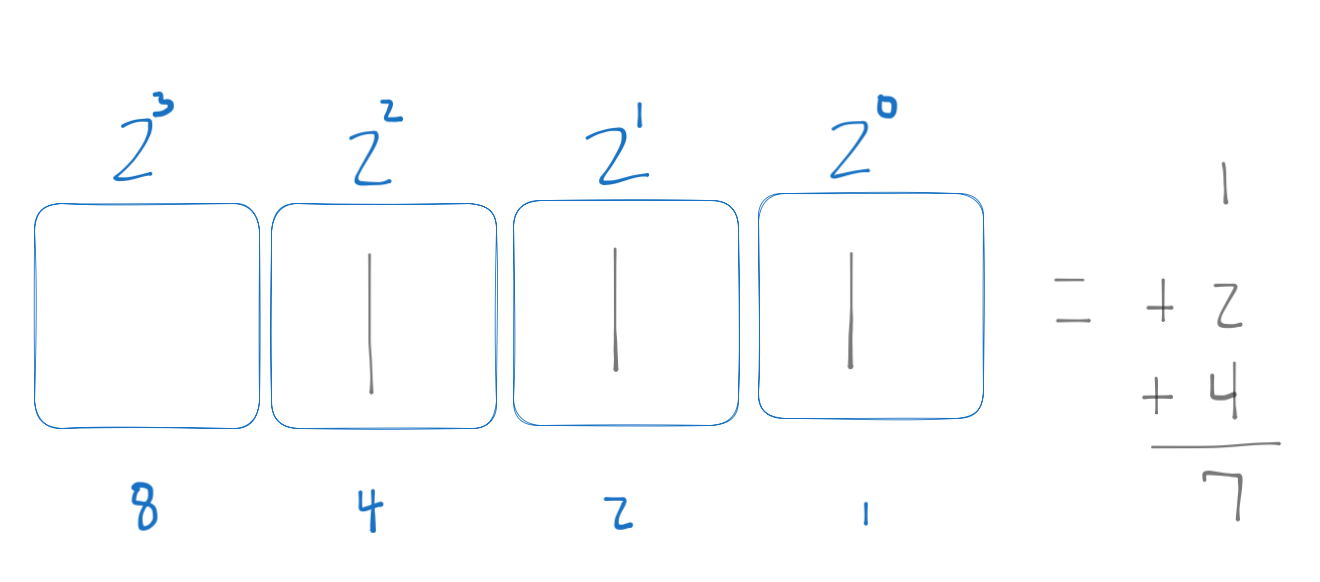
Ok, now, let's take a moment and look at counting in binary. If you've never done binary before, here is a toy:
Here are the first seven numbers including zero:
0
1
10
11
100
101
110
111
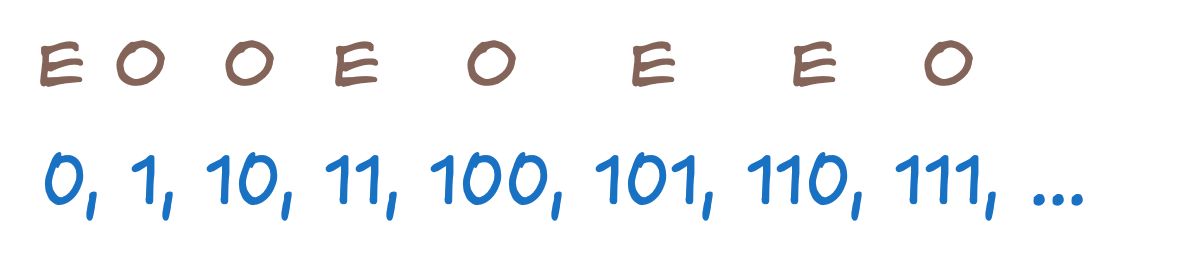
Now, add the number of 1's. If it is even mark it with an E and if it is odd mark it with an O.
E - 0
O - 1
O - 10
E - 11
O - 100
E - 101
E - 110
O - 111
- What do you notice about this pattern?
- Do you have any conjectures?
- What other questions can you pose?
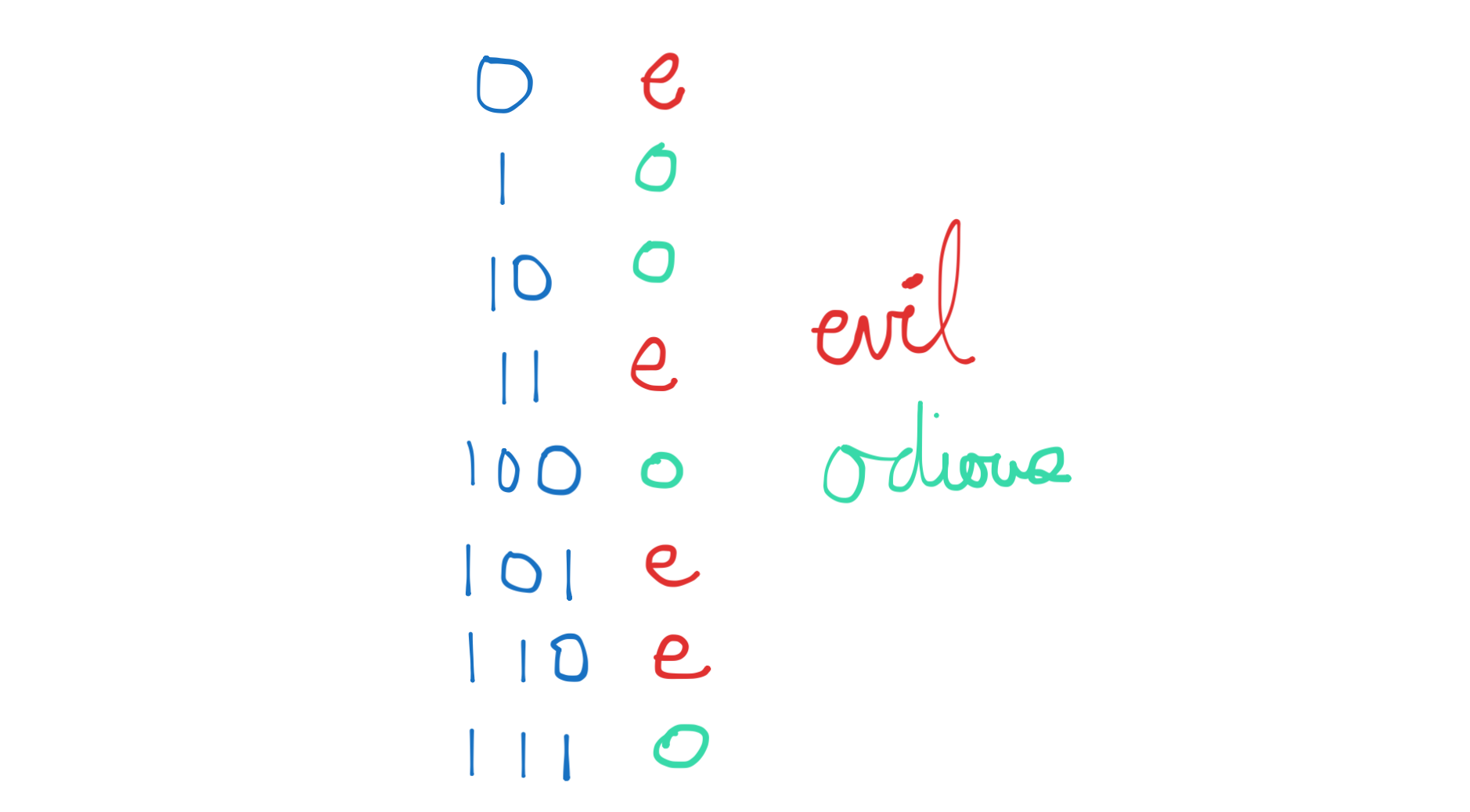
Aside: We love to name numbers. We have even, odd, prime, – what else? Happy, Perfect, Evil, Odious, and so much more. The E's and O's can stand for numbers that have even or odd ones in binary also known as Evil and Odious numbers.
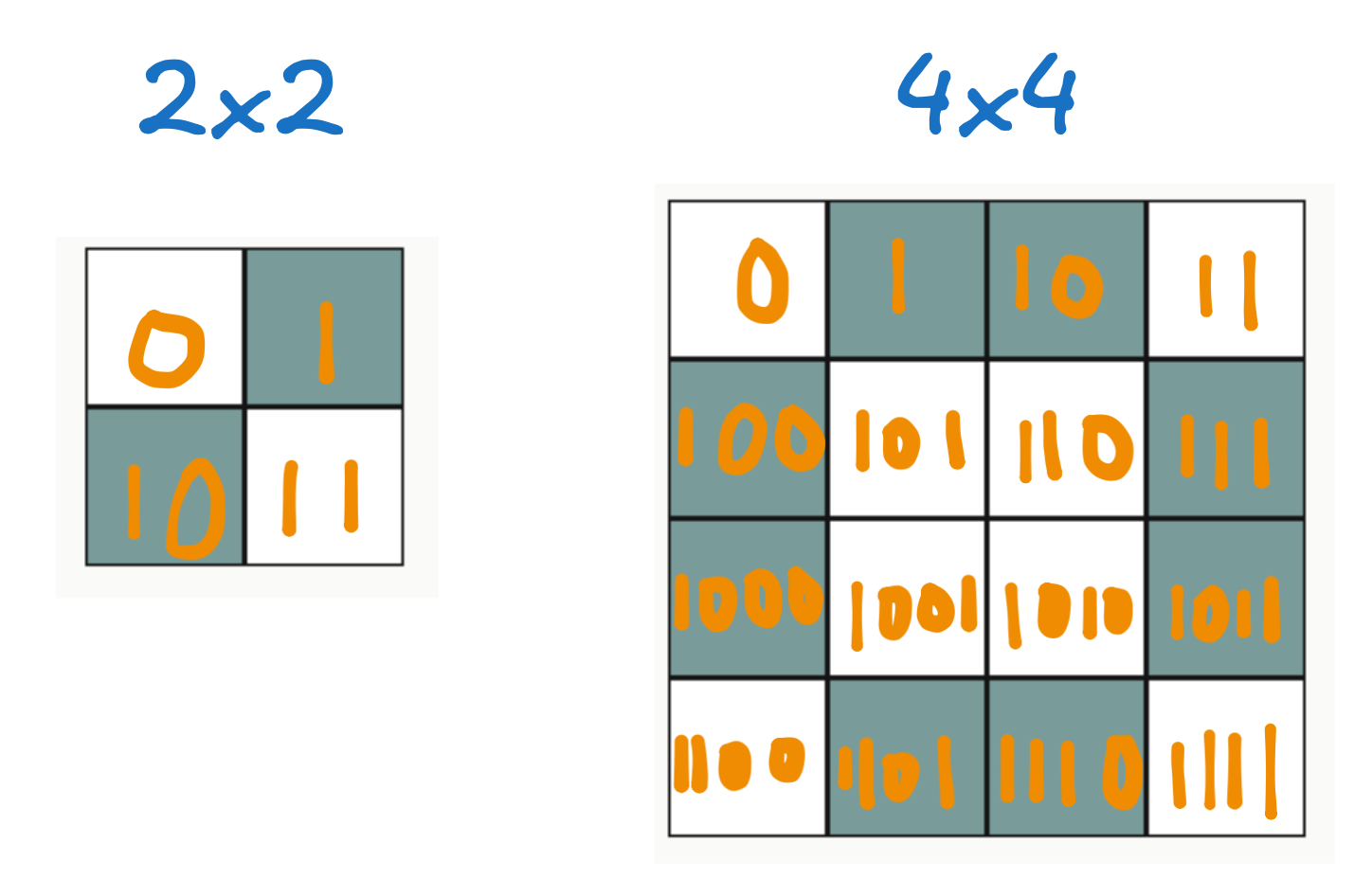
If you'd like to put binary numbers in a grid with O's shaded here is a toy below ( and also here):
Educator Resources
Spoiler alert — go play before proceeding (this means you too).
Activity Structure
This is a 30–60 minute activity. This is just one example - there are other hands-on ways to do this and many approaches to a proof and play.
Exploration of Pattern (5-10 minutes)
Start with E, then EO, then EOOE.
- What is the next in the pattern?
- Hypothesize and discuss - there are many possibiliities for patterns.
- Share reasoning and play on a whiteboard
- If EOOEOEEO wasn't given in discussion, add it and repeat.
- Group whiteboard (virtual or in person)
Once the pattern's construction is defined, put it aside for a moment.
Example conjectures and definitions:
"The second half of each row is always the flip of the first half."
"The E and O always appear in equal numbers."
"You can never have three Es or three Os in a row."
"Every other row reads the same forwards and backwards — it's a palindrome."
Exploration of Binary (5-15 minutes)
If learners are familar with binary, then review and skip.
Otherwise, introduce it:
- Let's count in binary:
- 0 is 0
- 1 is 1
- 2 is 10
- 3 is 11
- What comes next?
- share and discuss
- Let's do more:
- 4 is 100
- 5 is 101
- 6 is 110
- 7 is 111
- What would the next four be?
- Share, discuss, and reveal place values for binary.
- Supporting questions:
- Are there other patterns to find?
- Some learners may go to even odd without the next section's prompt.
- How do you double a number?
- Why are some numbers all 1's?
- What's up with the 1, 10, 100, 1000, 10000 numbers?
Exploration of Odious and Evil Numbers (5-10 minutes)
Alright! Let's look at our binary numbers and count the number of ones. If they have an even number of ones, mark them as E and odd as O.
This might look like this:
Or, maybe like this:
Learners might also put the binary in a square grid like 2x2 or 4x4 just like a 10x10 number chart:
Conjecture Formation - Pulling the two together (15–20 minutes)
Allow time to write down observations. Give examples of conjectures if needed.
Example Supporting questions:
This is highly dependent on the audience
- Is there a pattern in where the Es are? The Os?
- Do the two sequences match?
- You found the beginning copy and flip sequence is the same as the odious/evil sequence, why do you think that is?
- Can you test it? Can you find a position where they disagree?
- What does that mean? (you know what positions are ones?)
- Why would copy-flip produce the same pattern as counting 1s in binary?
- What happens at position 4? Position 8? What changes in binary at those moments?
- What is going on with the number grids with evil/odious shading?
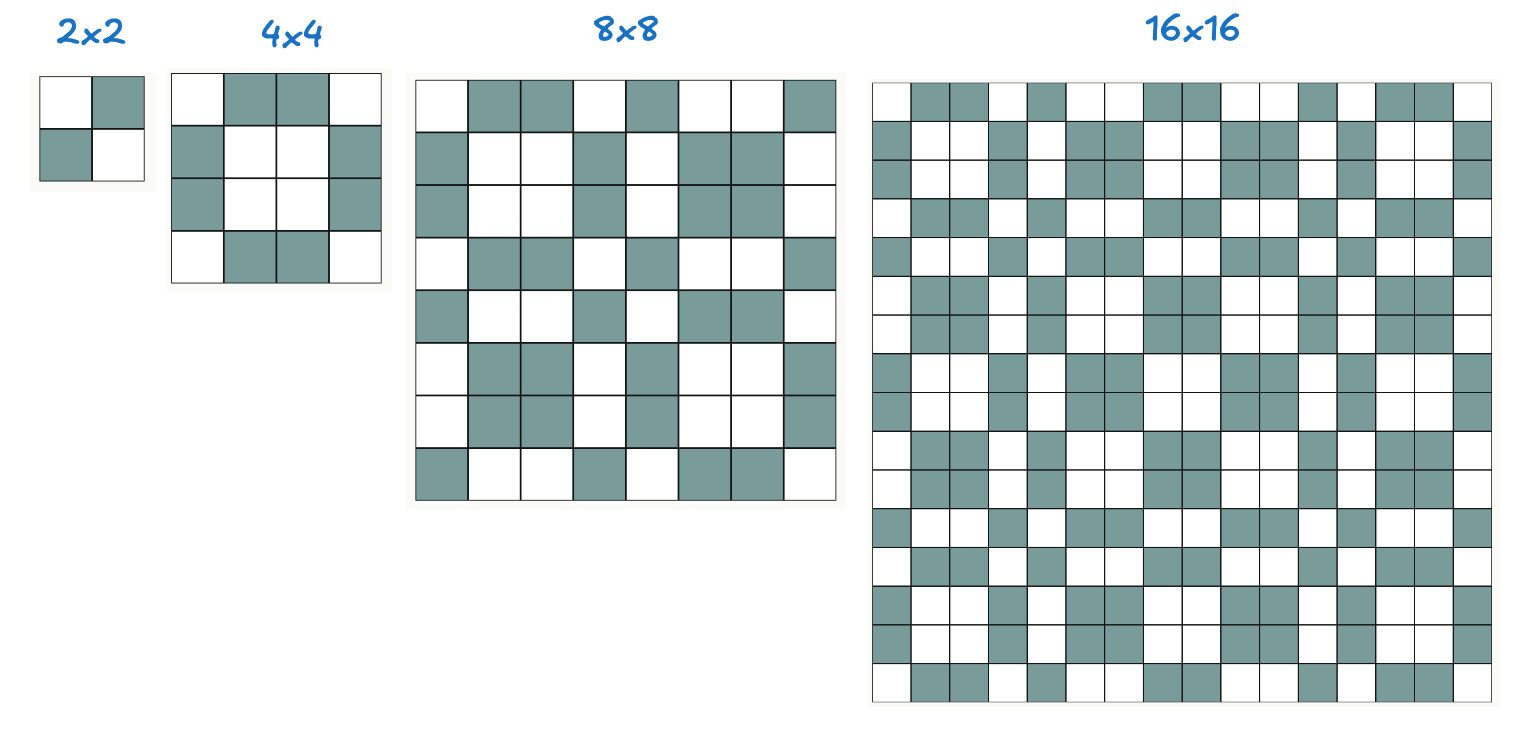
Example conjectures:
"The copy-flip sequence and the odious/evil sequence are the same."
"If you know a number is odious you know the letter in the EOOE sequence without building the sequence."
"Grids of n x n numbers follow the same pattern of copy and flip both horizontal and vertically. (Even powers of 2, or square numbers are symmetrical)"
"There are no three consecutive odious or evil numbers."
One approach toward a proof (10–15 minutes)
Supporting questions:
- What happens at positions 2, 4, 8, 16?
- What changes when you cross from 7 to 8 — what does 8 look like in binary?
- An extra 1 means...?
Let's start with zero and one:

and then lets copy it and flip the even/odd number of ones by prepending a 1 to the beginning:

Ok - let's do that again - copy, and flip the parity of even/odd ones by putting a 1 on the front:
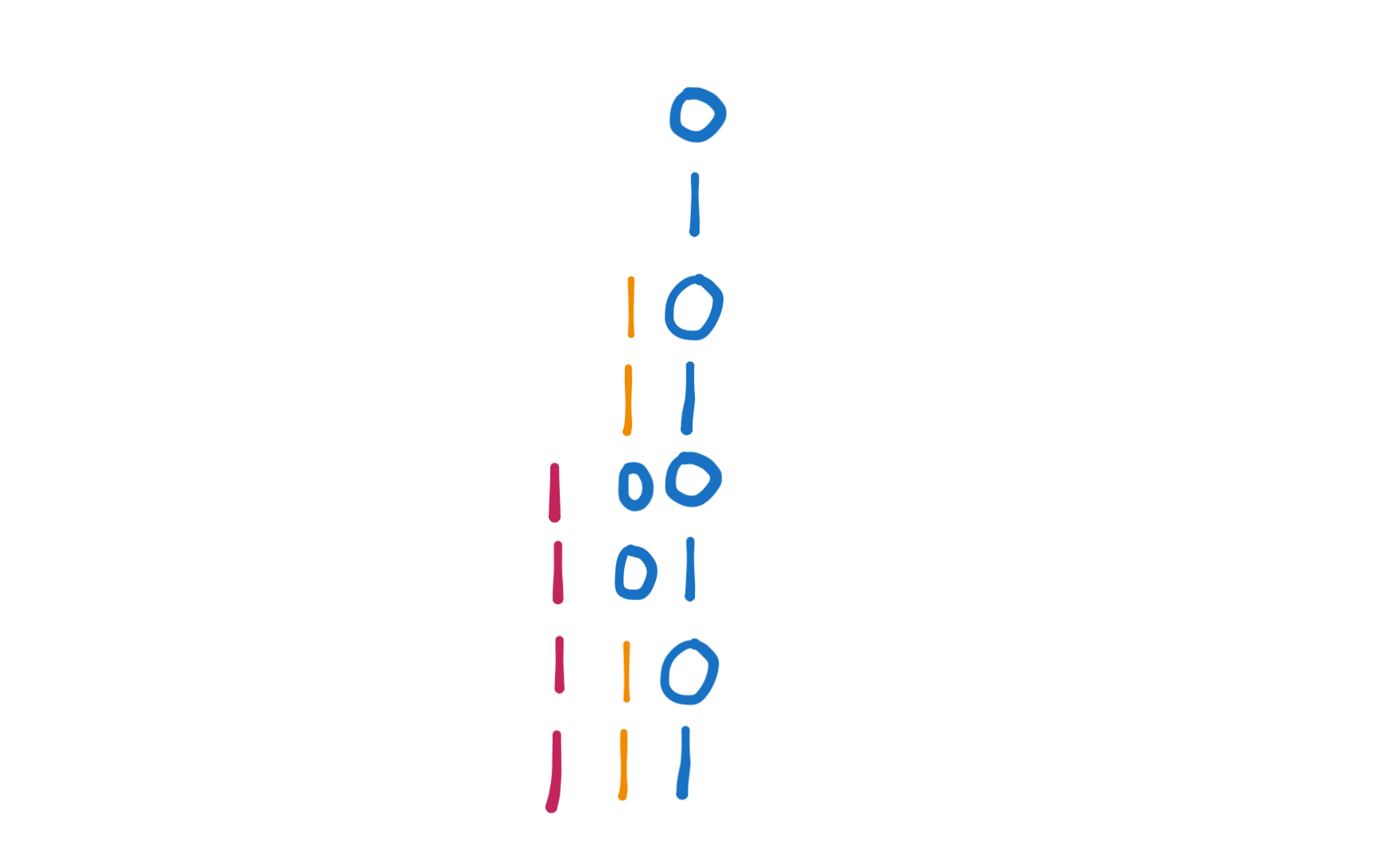
Wait a minute - this looks like binary? it seems like copying and then putting a one is like counting in binary. Is that true? Why?
What is happening with each copy and adding of 1?
Vocabulary
- Sequence: An ordered list of values following a rule.
- Parity: Whether a number is odd or even.
- Binary: Writing numbers using only 0s and 1s, with powers of 2 as place values.
- Odious number: A whole number whose binary representation has an odd number of 1s.
- Evil number: A whole number whose binary representation has an even number of 1s.
- Palindrome: A sequence that reads the same forwards and backwards.
Resources, Extensions, and What Ifs
- What if instead of flip you rotate? Do this with things other than numbers - like folding paper and the the dragon curve.
- What if you use three symbols?Four? What would flip or rotate rules look like?
- Fair division: The E/O sequence is the fairest way for two people to take turns choosing — used in sports drafts and fair division theory.
- Connections: Pisano periods, Pascal's triangle mod 2 (Sierpinski triangle), automatic sequences.
- Thue-Morse sequence: The formal name for the EOOE sequence.